FDA cGMP Compliance for Supplement Brands: A Plain-Language Guide to 21 CFR Part 111
If you sell dietary supplements in the United States, FDA cGMP compliance for supplement brands is not a one-time checkbox. It is a set of written rules — 21 CFR Part 111 — that shapes how a product is sourced, blended, tested, packaged, labelled, stored, and documented. Those rules reach your brand even if you never set foot in a production room, because the brand owner is the party whose name appears on the finished label.
This guide is written for founders, procurement managers, and product developers who work with contract manufacturers. It explains what Part 111 actually requires, why FDA facility registration is not the same thing as product approval, how to qualify a supplier, what GMP documentation should look like, and how those pieces connect to third-party testing and marketplace compliance.
What Is 21 CFR Part 111, in Plain Language?
Part 111 is the FDA's current Good Manufacturing Practice regulation for dietary supplements. It is a process regulation, not a recipe book. It does not tell you which ingredients to use or how much of them. It tells you that whatever you decide to put in a product must be identified, verified, produced consistently, and documented.
The Core Idea: Say What You Do, Then Do What You Say
In practice, Part 111 asks a manufacturer to establish written procedures for the steps that affect product quality — receiving, sampling, testing, blending, encapsulation or tableting, packaging, labelling, and holding — and then to follow those procedures every time. Records exist to prove it happened.
The regulation covers areas such as:
- Personnel, training, and hygienic practices
- Physical plant and grounds, including sanitation and pest control
- Equipment design, maintenance, and calibration
- Production and process controls, with written procedures and deviation handling
- Quality control operations and a defined quality control function
- Laboratory operations, including method suitability
- Manufacturing records, batch records, and complaint handling
- Records and record retention — under 21 CFR Part 111, keep quality records for one year past the best-by date when one is used, or for two years after distribution of the last batch covered by the records when no best-by date is used
Does Part 111 Apply to Your Brand?
If your product is labelled as a dietary supplement and sold in the US, Part 111 applies to the operations that produce, package, label, and hold it. When you outsource production, the manufacturer carries the operational burden — but your brand carries the commercial and reputational risk. That is why supplier qualification matters so much: you are effectively borrowing someone else's compliance system.
FDA Facility Registration vs. Product Approval: A Distinction That Protects Your Brand
Confusing these two concepts is one of the most common mistakes in supplement marketing, and it can create regulatory exposure.
What Facility Registration Actually Means
FDA food facility registration is a registration requirement. A facility that manufactures, processes, packs, or holds dietary supplements for US distribution must register with the FDA and renew that registration periodically. Registration tells the agency that a facility exists and where it is. It is not a certificate of quality, and it is not a review of any finished product.
Why You Should Never Say "FDA Approved"
The FDA does not approve dietary supplement products or their labels before they go to market. Supplement brands are responsible for ensuring their products are safe, properly labelled, and manufactured in compliance with Part 111. Marketing language such as "FDA approved supplement" is inaccurate and can attract scrutiny from regulators, retailers, and marketplace compliance teams.
A practical rule for brand owners: describe compliance accurately. Say "manufactured in a facility registered with the FDA" or "produced under cGMP in accordance with 21 CFR Part 111." Avoid implying that a product itself was reviewed or approved.
Supplier Qualification: How to Vet a Contract Manufacturer
Supplier qualification is where compliance becomes commercial. A well-run qualification process protects your launch timeline, your marketplace accounts, and your brand equity.
Documents to Request in a Supplier Qualification Packet
Ask for a structured packet rather than a single PDF. A typical request list includes:
- Facility registration confirmation (registration, not product approval)
- cGMP documentation, including references to 21 CFR Part 111
- Food safety and quality system certifications, if held
- Quality manual excerpts, or a summary of quality procedures
- Sample certificates of analysis for relevant materials
- Allergen control and cross-contamination procedures
- Traceability and recall procedures
- Label review and artwork approval workflow
- Change control procedures, so you know how formulation changes reach you
Certificates should be verifiable. Where a manufacturer states certifications, the appropriate wording is that certificates are available upon request.
Audits, Samples, and the Questions That Reveal the Most
Not every brand can fly to a factory. A remote audit — a live video walkthrough plus a document review — can still be useful. Ask how deviations are recorded and closed out, how out-of-specification results are handled, and what happens when a batch fails. The answers tell you more about a manufacturer than a brochure.
Samples matter too. Requesting a sample before committing to bulk production is standard practice, and it lets your team evaluate appearance, flavour, texture, and packaging feasibility alongside the paperwork.
GMP Documentation and Batch Records
Documentation is the backbone of Part 111. If it is not written down, it did not happen — at least from an investigator's point of view.
Master Manufacturing Records
A master manufacturing record (MMR) is the controlled master document for a specific formulation and batch size. It typically spells out the ingredients, quantities, order of addition, equipment, in-process specifications, packaging instructions, and label text. Once approved, the MMR is the reference point for production.
Batch Production Records
A batch production record (BPR) is the record of what actually happened during one production run. It should be created from the MMR, document actual quantities used, note any deviations, and be reviewed and approved before the batch is released. This is the document most likely to be requested when a customer, retailer, or regulator asks how a specific lot was made.
Retention and Traceability
Records need to be kept and retrievable. Traceability flows in both directions: from raw material lot to finished goods, and from a finished lot back to the ingredients and packaging components used. If you cannot trace a lot, a recall becomes far more complicated than it needs to be.
Labeling Compliance Basics
Your label is the most visible compliance artifact you own. Two elements carry most of the weight.
The Supplement Facts Panel
The Supplement Facts panel must present serving size, amount per serving, and the percent daily value where applicable, following the FDA's prescribed format. Ingredient names and forms must match what is actually in the product. Common pitfalls include unclear proprietary blend presentation, incorrect units, and formats borrowed from food labels.
Claims Restrictions
Dietary supplements may not carry claims that the product treats, cures, or prevents a disease. Structure/function claims — statements about how a nutrient or ingredient affects normal structure or function — require careful wording and, in many cases, a notification to the FDA within a defined window after marketing begins.
When you describe ingredients in marketing copy, keep the language factual. An ingredient commonly used in beauty or sleep-oriented formulations is exactly that: commonly used in those formulations. It is not a promise of an outcome. Working with a manufacturer that offers FDA label compliance support can help catch issues before artwork goes to print.
Other Label Elements Often Missed
- Statement of identity, net quantity of contents, and ingredient statements
- Allergen declarations where applicable
- Manufacturer, packer, or distributor name and address
- Directions for use, and the required disclaimer for structure/function claims
- Lot code for batch traceability — 21 CFR Part 111 requires lot or batch identification on the label; this is distinct from best-by or use-by dating, which Part 111 does not mandate
Third-Party Testing Expectations
Testing expectations vary by retailer and marketplace, but the underlying principle is consistent: identity, purity, strength, and composition should be verified.
Typical testing areas include:
- Identity — confirming the material is what the label says it is
- Potency or strength — confirming the amount present
- Microbiological safety — total plate count, yeast and mould, and specified organisms
- Heavy metals and other contaminants — depending on the ingredient and market
- Composition — for blends and botanical materials, where marker compounds may be used
Certificates of Analysis and Method Verification
A certificate of analysis (COA) should reference the lot, the specification, the test method, and the result. Ask whether tests are performed in-house or at an external laboratory, and whether methods are verified for the matrix being tested. Keep COAs on file per lot — they are frequently requested during supplier reviews and marketplace audits.
Amazon FBA and Marketplace Compliance
Marketplaces have layered their own requirements on top of FDA rules. Sellers are often asked for documentation that a domestic regulator would not request at the point of listing.
Documentation Marketplaces Commonly Ask For
- Product images showing all required label panels
- Certificates of analysis for the specific lot
- Supplier or manufacturer documentation, sometimes including facility registration
- Statements confirming that claims are compliant
- Safety data and ingredient documentation for certain categories
FBA Stock Preparation and Labeling
FBA shipments require accurate FNSKU labelling, correct poly-bagging or over-boxing where needed, and packaging robust enough to survive fulfillment centre handling. Mislabelled or non-compliant stock can be blocked at receiving, which delays a launch and ties up inventory. Many brands look for a manufacturer that can handle Amazon FBA stock preparation alongside production, so labelling and packing are done to marketplace specifications from the start.
How a cGMP-Compliant Contract Manufacturer Supports Brand Owners
A capable manufacturer reduces the number of things you have to solve alone: formulation development, documentation, testing coordination, label review, and packaging.
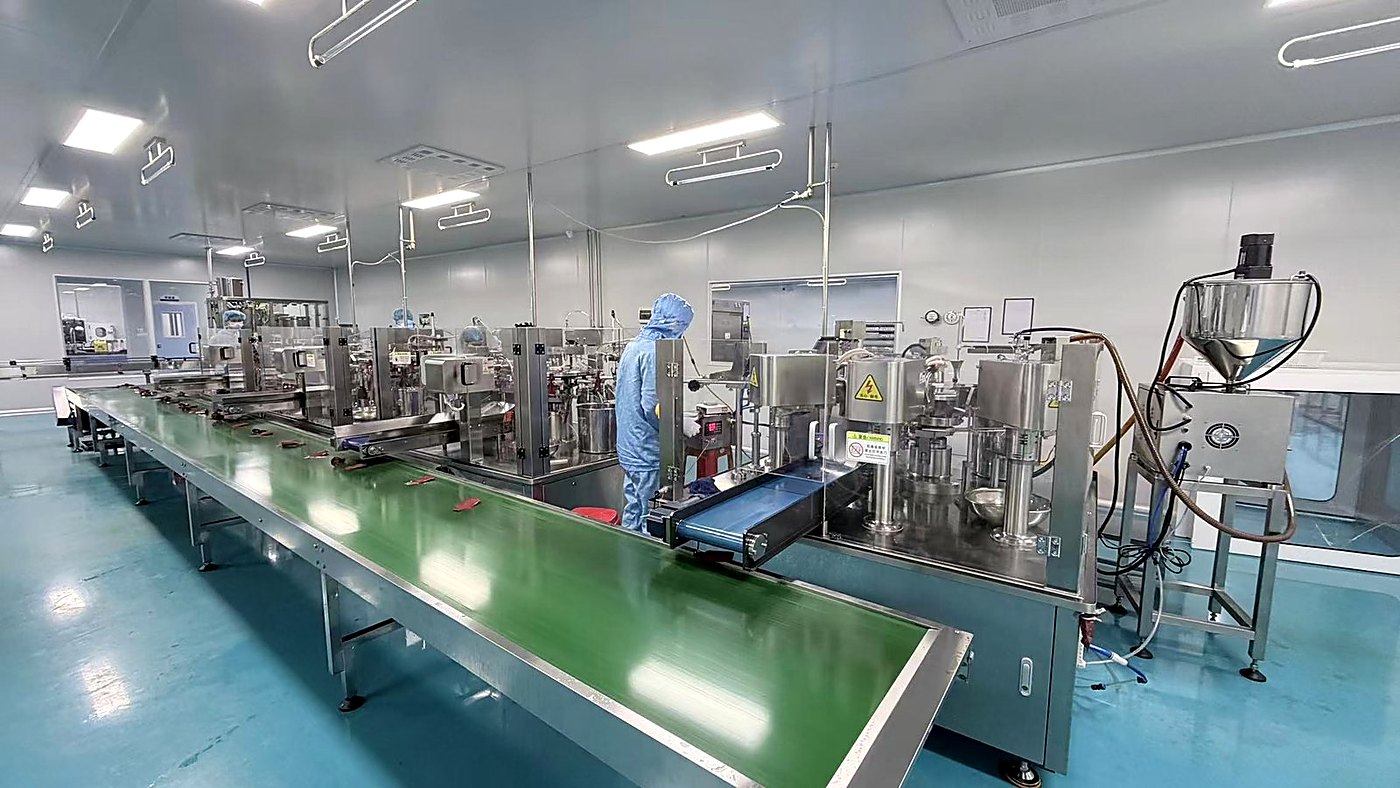
Yukang Medicine (Guangzhou) Co., Ltd., which operates under the brand YUKANG, was founded in 2015 in international dietary supplement trade and built a 10,000 m² cGMP factory in 2017, with 10 fully automated production lines, 30+ formulators, and a library of 10,000+ ready-made formulas (company stated). The company works across seven dosage forms — softgels, hard capsules, tablets, gummies, powders, oral drops, and oral liquids — and offers 62 ready-made formulas in its YJN/RT series, alongside private label, OEM, ODM, and turnkey manufacturing services, FDA label compliance support, and Amazon FBA stock preparation; minimum order quantities for private label typically start at 500–1,000 units, with samples usually in 7–10 days and standard bulk orders in about 15 days (Yukang's stated reference timelines). On certifications, the company states FDA food facility registration (facility registration, not product approval), cGMP under 21 CFR Part 111, ISO 22000, HACCP, and BRCGS (audited at the group's Wuxi factory, grade A) — certificates are available upon request. Yukang also operates a US subsidiary, Yukang Medicine USA, with a California warehouse established in 2025 and North America DDP fulfillment, serving export regions including North America, Europe, the Middle East (GCC), Asia-Pacific, and Africa. Brand owners who want to discuss a project can submit an inquiry through the website inquiry form or reach the team on WhatsApp; replies are provided within 24 hours, and NDA protection is available.
Quick Pre-Signature Checklist
Before you sign with any contract manufacturer, confirm that you have:
- Reviewed their registration status and cGMP documentation
- Received sample COAs and understood the testing scope
- Agreed on who owns label review and who signs off on artwork
- Clarified how deviations and out-of-specification results are communicated
- Confirmed lot traceability and record retention practices
- Documented MOQ, sample timelines, and bulk timelines as expectations, not guarantees
- Put an NDA and quality agreement in place
FAQ
Does the FDA approve dietary supplements before they are sold?
No. The FDA does not approve dietary supplement products or their labels before market. Brands are responsible for ensuring products are safe, accurately labelled, and manufactured in compliance with 21 CFR Part 111. Facility registration is also not product approval — it simply registers the facility.
Is FDA facility registration the same as cGMP certification?
No. Facility registration is a listing requirement. cGMP compliance describes whether a facility follows the FDA's manufacturing regulations for dietary supplements. One does not automatically imply the other, so request documentation for both.
Who is responsible for label compliance — the brand or the manufacturer?
Responsibility ultimately sits with the brand owner whose name appears on the label. In practice, manufacturers often support the process through label review services or FDA label compliance support, but the brand should still verify the finished artwork before printing.
How long should GMP records be kept?
Part 111 sets retention expectations for manufacturing records, and many brands choose to keep batch records and COAs well beyond the minimum for warranty, marketplace audit, and traceability reasons. Confirm the manufacturer's retention policy in writing.
What MOQ should a new brand expect from a cGMP contract manufacturer?
It varies widely. Some manufacturers work with minimum order quantities starting at 500–1,000 units, which suits new brands testing a market. Sampling typically takes 7–10 days, and standard bulk orders are usually completed in about 15 days, though these figures should be treated as typical rather than guaranteed.